Contractor Lead Generation: 9 Ways to Get More Jobs Without Buying Leads
Let's talk about the lead generation trap most contractors fall into.
You sign up for HomeAdvisor or Angi because you need work. You start getting leads—but they're shared with 4 other contractors. You bid low to compete. You win some, lose most. The leads that convert barely cover your costs after the platform takes their cut.
So you buy more leads. And more. Before you know it, you're spending $2,000-5,000/month on leads you don't own, competing against the same contractors for the same price-shopping customers, running on a hamster wheel that never stops.
I've talked to contractors who've spent $100,000+ on lead services over the years and have nothing to show for it. No brand. No reputation. No pipeline they control. Just a monthly bill and a prayer that the phone rings.
There's a better way. Let me show you how to build a lead generation system you actually own.
Why Lead Services Are a Trap (And When They're Not)
Before I trash lead services entirely, let me be fair: they have their place.
Lead services make sense when:
- You're brand new and need work immediately
- You're filling gaps during slow seasons
- You have excess capacity and can absorb low-margin jobs
- You use them alongside (not instead of) your own marketing
Lead services are a trap when:
- They're your only source of leads
- You're competing on price alone
- You can't track actual ROI per lead
- You're dependent on them for survival
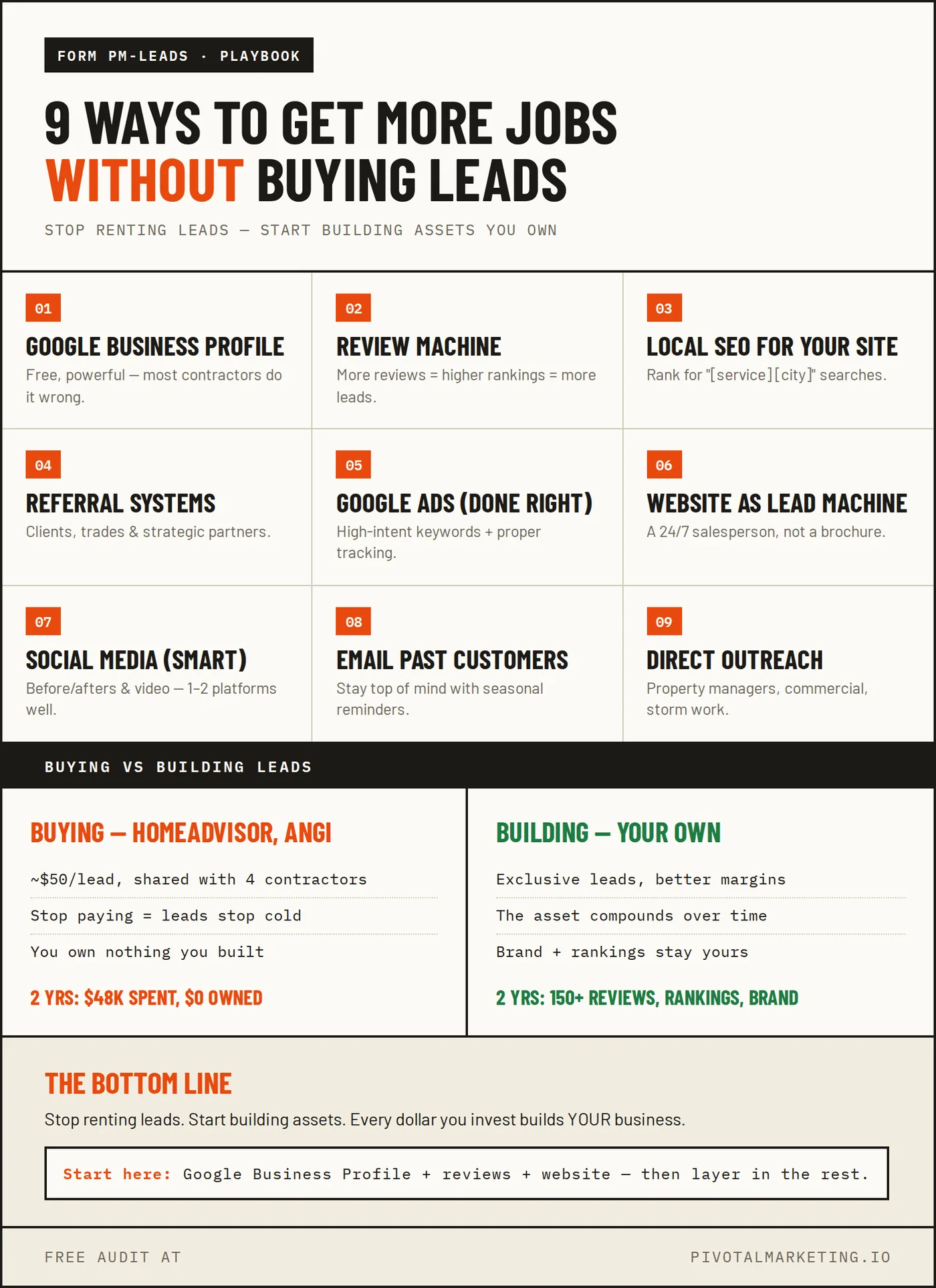
The fundamental problem: you're renting leads, not building an asset.
Every dollar you spend on HomeAdvisor builds HomeAdvisor's brand, not yours. When you stop paying, the leads stop. Meanwhile, every dollar you invest in your own marketing builds equity in YOUR business.
Let's talk about building that equity.
Strategy #1: Dominate Google Business Profile
If I could only do ONE thing for lead generation, it would be optimizing Google Business Profile (GBP). It's free, it's powerful, and most contractors do it wrong.
Why GBP Matters
When someone searches "contractor near me" or "roofer Minneapolis," Google shows three things:
1. Paid ads at the top
2. The "Map Pack" (3 local businesses with a map)
3. Organic website results below
The Map Pack gets the lion's share of clicks for local searches. And your Map Pack ranking is determined almost entirely by your Google Business Profile.
How to Optimize Your GBP
Complete every field:
- Accurate business name (no keyword stuffing)
- Correct address or service area
- Phone number (local, not 800 number)
- Website URL
- Hours of operation
- Business description (use keywords naturally)
Choose the right categories:
- Primary category: Most specific (e.g., "Roofing Contractor" not just "Contractor")
- Additional categories: All relevant ones (e.g., "Siding Contractor," "Gutter Cleaning Service")
Add services with descriptions:
- List every service you offer
- Include pricing ranges if comfortable
- Write detailed descriptions
Post weekly updates:
- Project photos
- Tips and advice
- Seasonal promotions
- Company news
Respond to every review:
- Thank positive reviewers specifically
- Address negative reviews professionally
- Always take heated discussions offline
The Secret Sauce: Photos
Most contractors have 3 sad photos from 2019. Top-ranking contractors have 50+ photos updated monthly.
Photos to add:
- Before/after project shots
- Work in progress
- Your team at job sites
- Your vehicles and equipment
- Happy customers (with permission)
Google loves fresh photos. They signal an active, engaged business.
Strategy #2: Build a Review Machine
Reviews are the currency of local lead generation. More reviews = higher rankings = more visibility = more leads. It's that simple.
The Numbers You Need
- 10 reviews: Minimum to look credible
- 30-50 reviews: Competitive in most markets
- 100+ reviews: Dominant position
How to Actually Get Reviews
Ask every single customer. Make it part of your process, not an afterthought.
Make it stupid easy:
1. Create a direct link to your Google review page
2. Save it as a short link or QR code
3. Text it to customers immediately after job completion
The timing matters: Ask when they're happiest—right after you finished the work and they're admiring the result.
Follow up once: If they don't review within 24 hours, send one reminder. That's it.
What NOT to do:
- Never buy fake reviews (Google will catch you)
- Never offer incentives (violates terms)
- Never ask only happy customers (review-gating)
- Never harass customers with requests
Responding to Reviews
Positive reviews: Thank them specifically. Mention the project. Show personality.
"Thanks Mike! That bathroom remodel was a fun one—glad you're enjoying the new tile work. Let us know if you need anything else!"
Negative reviews: Stay professional. Acknowledge frustration. Take it offline.
"We're sorry to hear about your experience. This isn't our standard of work. I'd like to discuss this directly—please call me at [number] so we can make this right."
Never argue publicly. Future customers are watching how you handle criticism.
Strategy #3: Local SEO for Your Website
Your Google Business Profile gets you in the Map Pack. Your website gets you in the organic results below. You want both.
On-Page Optimization
Homepage:
- Target your main keyword: "[Your trade] [Your city]" (e.g., "Roofing Contractor Minneapolis")
- Include it in: Page title, H1 heading, first paragraph, meta description
Service pages:
- Create separate pages for each service
- Target "[Service] [City]" on each (e.g., "Roof Replacement Minneapolis")
- Include detailed descriptions of what you do
Location pages:
- If you serve multiple cities, create pages for each
- Include genuine local content (not just city name swaps)
- Reference neighborhoods, landmarks, local context
Technical Must-Haves
- Mobile-friendly: Most searches happen on phones
- Fast loading: Under 3 seconds
- SSL certificate: https:// (not http://)
- NAP consistency: Same name, address, phone everywhere
Content That Attracts Leads
Write content that answers questions your prospects actually have:
- "How much does a roof replacement cost in [City]?"
- "Signs you need to replace your [thing]"
- "How to choose a [your trade] contractor"
- "[Your trade] vs DIY: What you need to know"
These articles attract people researching—and a percentage of those researchers become customers.
Strategy #4: Referral Systems That Work
Word-of-mouth is the best lead source. But passive referrals aren't a strategy. You need a system.
Client Referral Program
Make it worth their while:
- $50-100 gift card for each referral that books
- Discount on future work
- Entry into quarterly prize drawings
Make it easy:
- Give clients referral cards
- Send them a referral link via text
- Follow up 2 weeks after job completion to ask
Make it memorable:
- Thank them when referrals come in
- Send a handwritten note with the reward
- Stay top of mind with occasional check-ins
Trade Partnerships
Other contractors are your best referral source. Build relationships with trades that complement yours:
If you're a roofer: Partner with siding contractors, gutter companies, solar installers, real estate agents
If you're a plumber: Partner with HVAC contractors, electricians, general contractors, property managers
If you're an electrician: Partner with HVAC contractors, plumbers, solar companies, home builders
The pitch: "I'll send clients your way, you send them mine." No money changes hands—just mutual benefit.
Strategic Partners
Think beyond other contractors:
- Real estate agents: Need contractors for pre-listing repairs, buyer inspections
- Property managers: Ongoing maintenance needs across multiple properties
- Insurance adjusters: Storm damage, water damage, fire restoration
- Interior designers: Renovation and remodeling referrals
- Home inspectors: Refer issues they find to trusted contractors
One good partnership can generate 5-10 leads per month consistently.
Strategy #5: Google Ads (Done Right)
Google Ads can generate leads immediately—but most contractors waste money on them. Here's how to do it right.
Why Google Ads Work for Contractors
Someone searching "emergency plumber near me" at 2am has a problem they'll pay to solve NOW. That's high-intent traffic—worth paying for.
Setting Up Profitable Campaigns
Target the right keywords:
- "[Service] + [City]" (e.g., "roof repair Minneapolis")
- "[Service] near me"
- "Emergency [service]" (if you offer it)
Avoid broad keywords:
- "Contractor" (too vague)
- "Home improvement" (could be anything)
- "How to [DIY thing]" (researchers, not buyers)
Use location targeting:
- Only show ads in your service area
- Exclude areas you don't serve
- Consider higher bids for high-value neighborhoods
Write ads that qualify:
- Include your service area
- Mention specialties
- Set expectations ("Free estimates" or "Licensed & insured")
Budget and Bidding
Starting budget: $500-1,500/month to test
Cost per lead expectations:
- Low competition trades: $20-40/lead
- Medium competition: $40-80/lead
- High competition (roofing, HVAC): $80-150+/lead
Track everything:
- Set up conversion tracking
- Know your cost per lead
- Know your cost per acquired customer
- Calculate ROI per campaign
Google Local Service Ads
LSAs appear at the very top of search results with a "Google Guaranteed" badge. You pay per lead, not per click.
Requirements:
- Background check
- License verification
- Insurance verification
Why they're often better than regular Google Ads:
- Pay only for actual leads (not clicks)
- Google Guaranteed badge builds trust
- Appear above regular ads
Cost: $15-75 per lead depending on trade and market
Strategy #6: Your Website as a Lead Machine
Your website should be a 24/7 salesperson, not a digital brochure.
Above the Fold Essentials
When someone lands on your site, they should immediately see:
- What you do: "Roofing Contractor Serving Minneapolis"
- Proof you're good: Stars, review count, years in business
- How to contact you: Phone number (click-to-call) AND form button
Lead Capture Forms
Keep it short:
- Name
- Phone
- Service needed
- Brief description
Make it obvious:
- "Get a Free Estimate" button on every page
- Sticky header with contact info
- Form in the footer
- Pop-up (not annoying) after 30 seconds
Respond fast:
- Customers buy from whoever responds first
- Aim for under 5 minutes during business hours
- Under 1 hour evenings/weekends
Trust Elements
- Reviews: Embed Google reviews on your site
- Photos: Real project photos, not stock images
- Certifications: Manufacturer certifications, licenses, insurance
- Team: Real photos of your actual team
- Guarantees: Warranty info, satisfaction guarantee
Case Studies / Portfolio
Show, don't tell. Create pages showing:
- The problem the customer had
- Your solution
- Before/after photos
- Customer testimonial
- Scope of work
These convert browsers into callers.
Strategy #7: Social Media (Without Wasting Your Life)
Social media CAN work for contractors—but most do it wrong.
What Works
Before/after photos: Transformation content performs incredibly well. People love seeing dramatic results.
Video content:
- Time-lapse of projects
- Quick tips ("How to tell if your [thing] needs replacing")
- Team introductions
- Behind-the-scenes of interesting projects
Local community content:
- Projects in recognizable neighborhoods
- Local events you're involved in
- Community sponsorships
What Doesn't Work
- Generic "We're the best!" posts
- Posting once every 3 months
- Only promotional content
- Arguing in comments
- Ignoring messages
Where to Focus
Facebook: Best for local reach. Post in local groups (helpfully, not spammy). Run targeted ads.
Instagram: Good for visual trades (roofing, landscaping, remodeling). Before/afters do great.
YouTube: Time-lapses, tutorials, project walkthroughs. Long-term traffic source.
Nextdoor: Extremely valuable for contractors. Be helpful in discussions. Don't spam.
TikTok: Growing opportunity. "Satisfying" project videos do well.
LinkedIn: Only if you do commercial work.
Pick 1-2 platforms and do them well. Better than being mediocre everywhere.
Strategy #8: Email Marketing to Past Customers
Your past customers are your warmest leads. They already trust you, know your work, and will need your services again.
Build Your List
- Collect emails from every customer
- Add them to your CRM or email list
- Segment by service type and date
What to Send
Seasonal reminders:
- "Time for your annual [maintenance]"
- "Prepare for [season] with these tips"
- "Schedule now before the rush"
Helpful content:
- Maintenance tips
- Warning signs to watch for
- Home improvement ideas
Special offers:
- Past customer discounts
- Referral incentives
- Priority scheduling
Frequency
Don't spam. Monthly is plenty for most contractors. Seasonal trades might do quarterly.
The goal: stay top of mind so when they need work (or a friend asks for a recommendation), you're the first name they think of.
Strategy #9: Direct Outreach
Sometimes the best leads come from going after them directly.
Target Property Managers
Property managers control dozens or hundreds of units. One relationship = ongoing work.
How to approach:
- Find local property management companies
- Send a professional intro letter
- Follow up with a call
- Offer to be their go-to for your trade
- Be responsive when they call (this is their #1 complaint about contractors)
Commercial Properties
Businesses need contractors too:
- Office buildings
- Retail spaces
- Restaurants
- Warehouses
- Apartment complexes
Drive around, note properties that need work, and reach out to the owners/managers.
Storm/Disaster Response
After storms, roofing/restoration contractors see a surge in demand. Be prepared:
- Have door hangers ready
- Canvas affected neighborhoods quickly
- Offer free inspections
- Build relationships with insurance adjusters
Ethically done, this is valuable service. Don't be a storm chaser who disappears.
Tracking Your Lead Generation ROI
You can't improve what you don't measure. Track these metrics:
For Each Lead Source
- Number of leads: How many inquiries?
- Cost per lead: Total spend / leads
- Conversion rate: What percentage become customers?
- Average job value: Revenue per converted lead
- Cost per acquisition: Total spend / customers acquired
- ROI: Revenue / spend
Tools You Need
- CRM: Track every lead from first contact to job completion
- Call tracking: Different phone numbers for different sources
- Form tracking: Know which form captured which lead
- Ask every customer: "How did you hear about us?"
Monthly Review
Look at your numbers monthly:
- Which sources generate the most leads?
- Which sources have the best conversion rates?
- Which sources have the highest ROI?
- Where should you invest more? Less?
Double down on what works. Cut what doesn't.
Building vs. Buying: The Long-Term Math
Let's do the math on owned vs. rented leads:
Buying Leads (HomeAdvisor/Angi)
- Spend: $2,000/month
- Leads: 40 ($50 each)
- Close rate: 20% (shared leads = price competition)
- Jobs: 8
- Average job: $2,500
- Revenue: $20,000
- Lead cost: 10% of revenue
After 2 years: $48,000 spent. Nothing to show for it if you stop paying.
Building Your Own Lead Machine
- Spend: $2,000/month (SEO, website, ads, content)
- Leads (Year 1): 20/month (building takes time)
- Leads (Year 2): 50/month (momentum builds)
- Close rate: 35% (exclusive leads = less price competition)
- Average job: $3,000 (better leads = better margins)
After 2 years: $48,000 invested. You now have:
- A website ranking for dozens of keywords
- 150+ Google reviews
- A referral network generating leads
- An email list of past customers
- Brand recognition in your market
Year 3 and beyond: Lead costs drop while volume increases. The asset you built keeps producing.
The Bottom Line
Stop renting leads. Start building assets.
Every dollar you invest in your own marketing builds equity in YOUR business. It compounds over time. It doesn't disappear when you stop paying.
Yes, it takes longer to build than buying leads. Yes, it requires effort and consistency. But 2-3 years from now, you'll either be dependent on lead services forever—or you'll have a lead generation machine you own.
The contractors who build the most valuable businesses choose the second path.
Ready to build your own lead generation system? Check out our local SEO services or get a free marketing audit to see where you stand.
---
Word count: ~2,500 words. Last updated: December 2025.